
A Strategic Proposal from the MLDC Based on the Community Developmental State (CDS)
Prof. Jimmy Yab. President of the MLDC. President of the Francophone China–Africa Observatory (OCAF). Professor of International Relations.
Abstract
In a global context of shifting power poles, Cameroon remains deeply anchored in diplomatic frameworks inherited from colonialism, even as South–South dynamics are redrawing the paths of development. This article puts forward a strategic alternative led by the Mouvement pour la Libération et le Développement du Cameroun (MLDC): the creation of a structured bilateral cooperation axis between Cameroon and Nigeria, framed by the Community Developmental State (CDS) model. Drawing inspiration from Asian models of planned industrialization and pragmatic diplomacy, this partnership could accelerate regional integration, reinforce Cameroon’s economic sovereignty, and stabilize border zones through development-oriented diplomacy. The analysis draws upon recent economic data, academic references, and the author’s experience as president of the Francophone China–Africa Observatory (OCAF).
1. Introduction: The Urgency of Diplomatic Refoundation
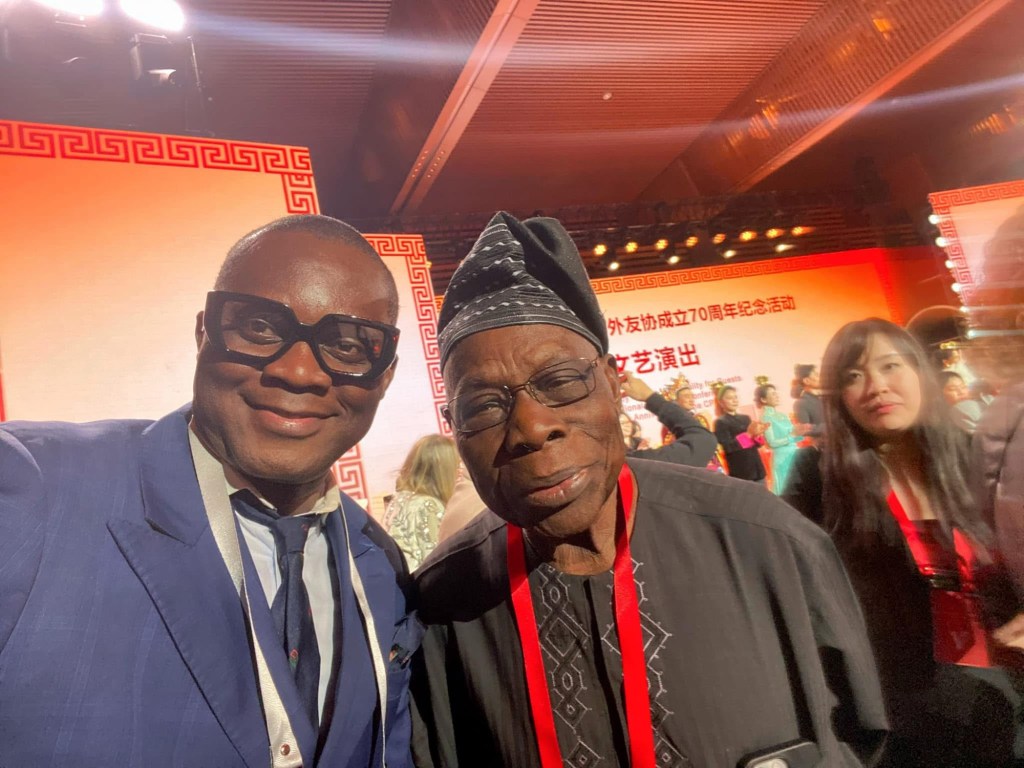
A photo taken during the 70th anniversary of the Chinese People’s Association for Friendship with Foreign Countries (CPAFFC) in Beijing—where the author was the sole representative of Cameroon, standing alongside President Olusegun Obasanjo—is more than symbolic. It illustrates a strategic vacuum in Cameroon’s diplomatic presence. While the world is restructuring around regional South–South alliances (Cheru & Obi, 2010), Cameroon remains absent from major co-development platforms, held captive by a France-centric diplomatic approach.
This diplomatic absence signals a structural crisis of vision, which the MLDC seeks to overcome through a developmental diplomacy rooted in the sub-region, positioning Nigeria as a first-tier strategic partner. Within this framework, the Community Developmental State offers the doctrinal and institutional basis to envision a new African regional order, led by sovereign and mutually supportive states.
2. Doctrinal Foundations: The Community Developmental State as a Lever for Regional Integration
Inspired by Asian models (Japan, South Korea, China, Vietnam), the Community Developmental State advocated by the MLDC rests on three pillars of sovereignty: political, economic, and technological (Yab, 2024). It breaks away from paradigms of dependence on international donors in favor of national planning and regional integration.
As Leftwich (1995) emphasizes, development does not arise from automatic market liberalization, but from the strategic autonomy of a state embedded in its national and regional communities. The CDS reframes foreign action not as passive representation but as a public policy of structural transformation.
3. Nigeria: An Underutilized Power in Cameroon’s Regional Strategy
With a GDP of $477 billion (IMF, 2023), a population exceeding 230 million, vast gas reserves, and a growing manufacturing sector, Nigeria is the continent’s leading economic power. Yet, Cameroon has never developed a high-level bilateral cooperation framework with Abuja—despite sharing a 1,500 km border and informal trade flows estimated at over $500 million in 2022 (BEAC, 2023).
The MLDC proposes transforming this informal border coexistence into a structured co-development axis, built around logistical corridors (Garoua–Maiduguri, Bamenda–Enugu), joint economic zones, and industrial cooperation on regional value chains (livestock, textiles, agriculture, energy).
4. Academic and Operational Diplomacy: The Role of OCAF
As President of the Francophone China–Africa Observatory, the author has conducted numerous comparative analyses on Sino-African cooperation modalities. Contrary to simplistic interpretations, China does not impose a single model but offers a flexible negotiation framework in which the partner state remains responsible for its agenda (Brautigam, 2009).
It is this strategic school that informs our proposal: a co-diplomacy of development, in which Cameroon co-constructs with Nigeria:
A Cameroon–Nigeria Institute for South–South Development, based in Garoua or Maroua, to train regional cooperation personnel; Joint university programs linking Yaoundé I, Douala, Ibadan, Nsukka, Zaria, to share expertise in agriculture, health, security, and industry; A shared strategy to attract African and Asian FDI, particularly for financing common infrastructure.
5. Regional Security: Peace Through Integrated Development
The Cameroon–Nigeria border, particularly in the Far North, remains plagued by multiple forms of insecurity: Boko Haram, cross-border banditry, extreme poverty. The MLDC proposes a doctrine of developmental security, inspired by the concept of “human security” (UNDP, 1994), which integrates military action, social inclusion, and economic integration.
This doctrine is based on:
Joint community-based security forces, funded by both states; Economic stabilization projects in at-risk areas (roads, schools, hospitals); Regional reintegration centers for former combatants, linked to literacy and vocational training programs.
6. A Strategic Break from Passive Diplomacy
Unlike Cameroon’s current foreign policies, which rely on symbolic representation and influence, the MLDC’s approach is grounded in impact diplomacy, oriented toward sovereignty and development goals.
The proposed Cameroon–Nigeria axis adopts an offensive posture, based on a realistic reading of the regional environment. It aligns with the notion that well-crafted South–South alliances are now strategic levers comparable to past bilateral treaties with Northern powers (Mohan & Tan-Mullins, 2019).
Conclusion: Toward a Pan-African Developmental Geodiplomacy
The MLDC puts forward a true geopolitical shift for Cameroon. By reorienting Cameroonian diplomacy toward pragmatic South–South partnerships—beginning with Nigeria—it restores foreign policy to its historical mission: supporting national independence, accelerating development, and ensuring peace.
The Community Developmental State is not merely an administrative model but a strategic and operational framework for situating Cameroon within a strong, integrated, and sovereign Africa.
“Those not at the negotiation table are on the menu of history.”
— Prof. Jimmy Yab
References
Brautigam, D. (2009). The Dragon’s Gift: The Real Story of China in Africa. Oxford University Press.
Cheru, F., & Obi, C. (2010). The Rise of China and India in Africa: Challenges, Opportunities and Critical Interventions. Zed Books.
Evans, P. (1995). Embedded Autonomy: States and Industrial Transformation. Princeton University Press.
IMF. (2023). World Economic Outlook. International Monetary Fund.
Leftwich, A. (1995). Bringing Politics Back In: Towards a Model of the Developmental State. Journal of Development Studies, 31(3), 400–427.
Mohan, G., & Tan-Mullins, M. (2019). The Geopolitics of South–South Infrastructure Development: Chinese-Funded Transport Projects in Ethiopia and Kenya. Political Geography, 73, 31–43.
UNDP. (1994). Human Development Report 1994: New Dimensions of Human Security. United Nations Development Programme.
Yab, J. (2024). Construction d’un État Développementaliste Communautaire : Le Cameroun. US Editions.
BEAC. (2023). Report on Informal Trade Flows in CEMAC. Bank of Central African States.
 Jimmy Yab