
Abstract
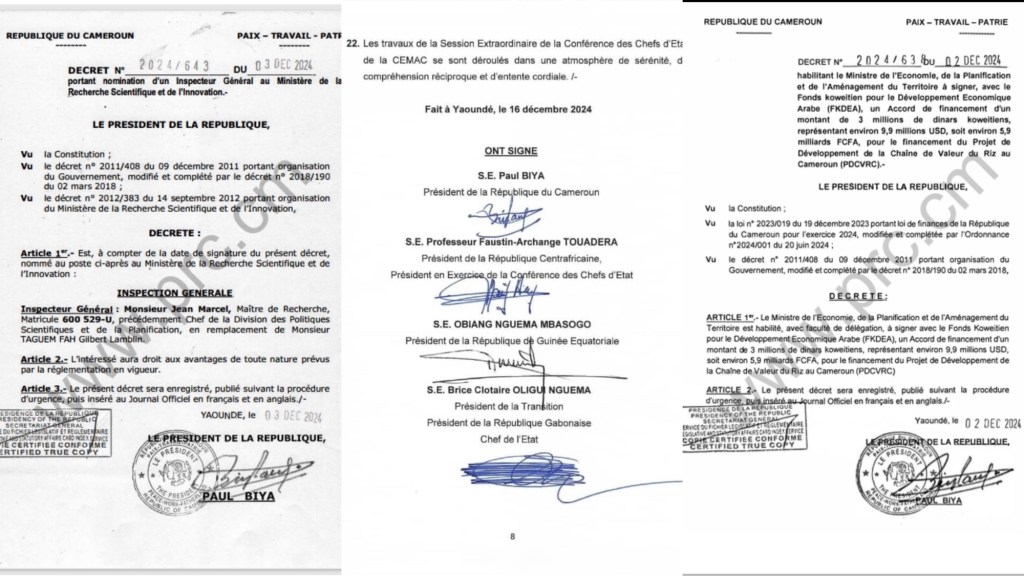
This article scientifically analyzes the authenticity of signatures affixed to recent decrees from the Presidency of the Republic of Cameroon. Using the presidential signature captured live and publicly broadcast during the Final Communiqué of the Extraordinary CEMAC Summit held in Yaoundé on December 16, 2024, we compare this signature with those found on official decrees signed in early December 2024. The observed discrepancies raise significant questions about potential falsification or manipulation of these documents. This study highlights the consequences of such manipulation on the credibility of the State, national trust, and Cameroon’s international relations. Finally, it offers recommendations to restore transparency and strengthen document security mechanisms.
Keywords
Presidential signature, Document authenticity, Political manipulation, Trust crisis, Document security, Cameroon, MLDC, Friedman, Paul Biya, Dawson, Martin et Smith.
Introduction
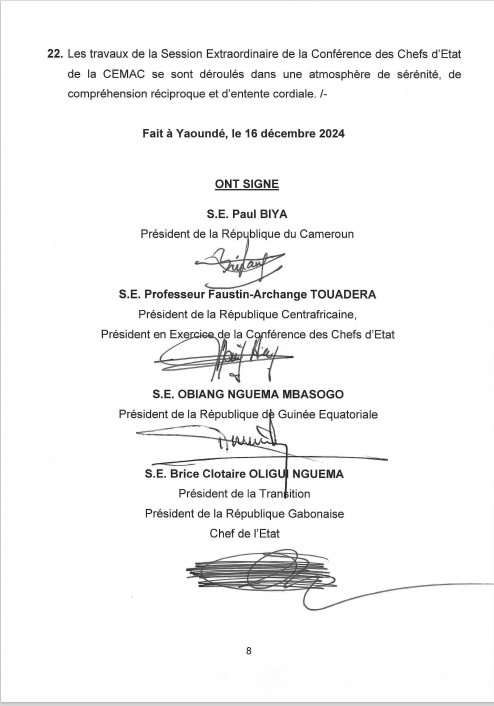
The presidential signature occupies a central place in the functioning of the State. It guarantees the legitimacy of the administrative and political acts of the executive branch, while embodying national sovereignty. During the CEMAC Extraordinary Summit held on December 16, 2024 in Yaoundé, the signature of the President of the Republic, Paul Biya, was carried out live, under the watchful eye of the heads of state present and the international media. This signature, broadcast on television, thus constitutes an authentic visual reference.
However, an in-depth analysis of recent decrees signed in early December 2024 reveals troubling divergences. These signatures, which differ from the visual reference of the CEMAC Summit, raise fundamental questions: is this a falsification or an administrative error? The implications of such manipulation could be disastrous for institutional stability, public confidence and Cameroon’s reputation on the international scene. As Friedman (2021) points out, “the integrity of official documents is the cornerstone of democratic governance and the rule of law.”
This article, structured around a scientific analysis of signatures, examines these inconsistencies using rigorous visual and graphological comparison methods. It also explores the possible consequences of falsification and proposes concrete solutions to ensure the integrity of official documents in the future.
A. Methodology
The approach adopted is based on a multi-step methodology aimed at establishing the reliability of the presidential signatures examined:
- Collection of official documents from the official website of the Presidency of the Republic of Cameroon: https://www.prc.cm
The decrees analyzed include:
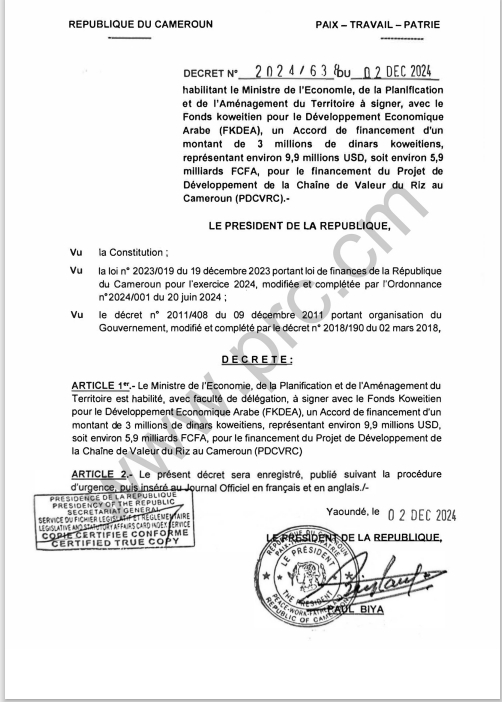
1.1. Decree No. 2024/638: financing of the rice value chain.
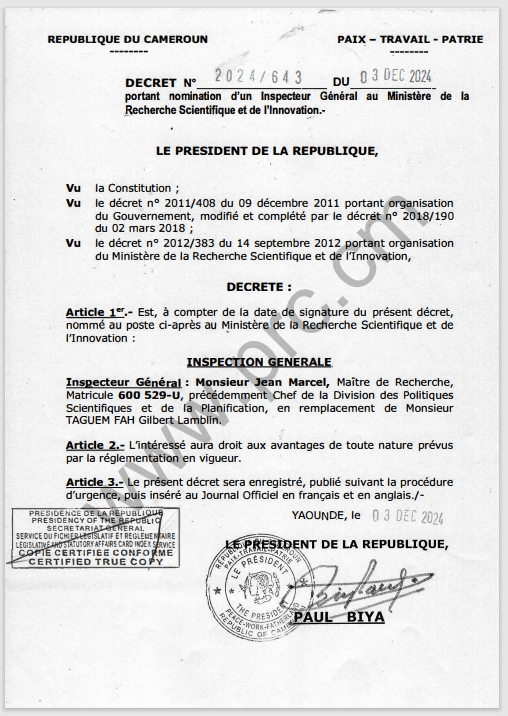
1.2. Decree No. 2024/643: appointment to the Ministry of Scientific Research
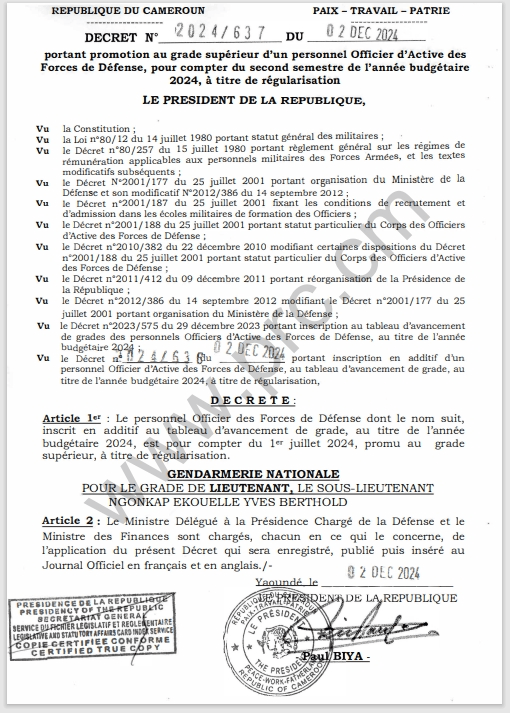
1.3. Decree No. 2024/637: promotion to the higher rank of the defense forces
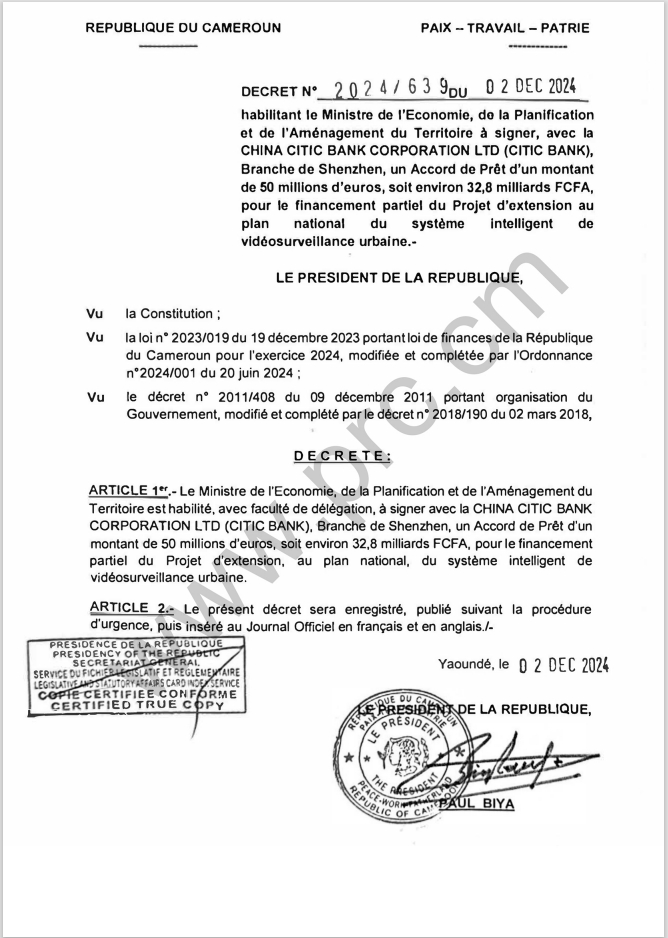
1.4.Decree No. 2024/639: financing of the video surveillance system.
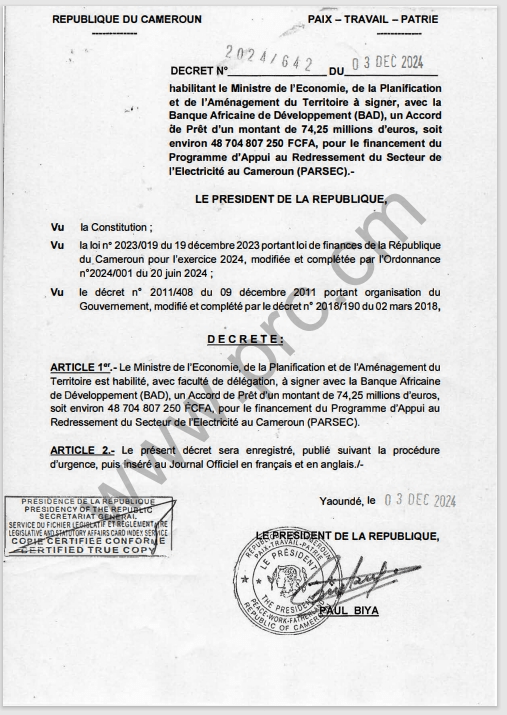
1.5. Decree No. 2024/642: loan for the electricity sector
- Comparative analysis of signatures
Scientific analysis of discrepancies:
Each signature was visually and graphically evaluated to identify anomalies that could suggest manipulation. Signatures were compared according to the following criteria:
-Letter inclination: the regularity of the writing.
-Pen pressure: uniformity of the strokes, thick and thin areas.
-Fluidity of the curves: consistency and continuity of the handwritten movement.
2.1. Reference signature:
The signature made live during the CEMAC Final Communiqué constitutes the standard of comparison.This methodology is based on proven techniques in documentary analysis. As Martin and Smith (2020) note, “a forged signature is distinguished by a lack of natural fluidity and an absence of continuity in the strokes.”
B. Analysis of Signatures of Decrees and Results
Decree No. 2024-638 and Decree No. 2024-637:
When examining the signatures affixed to these two decrees, several inconsistencies appear:
-The inclination of the letters is irregular, unlike the authentic signature.
-The pressure of the pen varies excessively, with abnormally thick areas.
-Some letters appear distorted or hesitant, which is not characteristic of natural writing.
Decree No. 2024-639:
In this decree, the signature presents more rigid and mechanical strokes, suggesting a possible automated reproduction. The visual comparison clearly shows a lack of fluidity.
Decree No. 2024-642 and Decree No. 2024-643:
These two signatures are the most troubling. They display striking differences with the reference signature, including:
-Misaligned letters.
-A disproportion in the curves and loops.
-A lack of continuity in the movement of the pen.
These inconsistencies, compared to the authentic signature of the Final Communiqué, suggest a potential manipulation or a potential falsification.
C. Consequences of a Manipulation
- Crisis of National Confidence
The falsification of the presidential signature is an extremely serious act that can lead to a total breakdown of trust between the Cameroonian people and their institutions. The signature of the Head of State symbolizes the sovereignty, legitimacy and continuity of the State. When doubt arises about the authenticity of such a signature, it calls into question the validity of the decrees and decisions taken, thus weakening the foundations of the social contract between the governors and the governed. A generalized loss of confidence can extend to all structures of the State, in particular public administrations, law enforcement and the judicial system, perceived as complicit or ineffective in the face of such manipulation. Furthermore, this crisis of legitimacy could give rise to citizen protests, fueling a climate of social and political instability. The Cameroonian people, already facing many socio-economic challenges, would see this situation as further proof of weak governance. Ultimately, this crisis could delegitimize all decisions taken by the government, leading to a blockage of reforms and projects necessary for the country’s development. As Dawson (2019) points out, “trust is the oxygen of democratic institutions. When this oxygen becomes scarce, society suffocates.” - International Repercussions
The manipulation of a presidential signature is not limited to national borders. It has direct consequences on Cameroon’s diplomatic and economic relations with its international partners. International organizations such as the African Development Bank (AfDB) or the International Monetary Fund (IMF), which finance projects essential to the country’s development, could suspend their financing agreements until the situation is clarified. Such a decision would compromise infrastructure, health or education projects, plunging the country into a major economic crisis. In addition, foreign investors, already cautious in an African context often perceived as risky, would turn away from Cameroon, weakening its economic attractiveness. In diplomacy, the credibility of a State is based on the consistency and transparency of its actions. Confirmed manipulation would permanently tarnish Cameroon’s image on the international scene, leading to political and economic consequences. As Friedman (2021) states, « a State that fails to guarantee the integrity of its official documents exposes itself to global distrust ». - Weakening the Rule of Law
The rule of law is based on citizens’ trust in the authentic and legitimate nature of the decisions taken by their leaders. A falsification of the presidential signature would weaken this fragile balance. Indeed, if official documents, supposed to be irreproachable, are found to be manipulated, this would open the door to more serious abuses such as systemic corruption or the falsification of other crucial decisions. The judicial system would also be called into question, as citizens could doubt its ability to sanction those responsible for such fraud. Such manipulation encourages the development of a culture of impunity, where forgers go unchallenged, which undermines the effectiveness of public institutions. This situation would set a dangerous precedent, where laws and rules would be perceived as manipulable according to personal or political interests. As Martin and Smith (2020) remind us, “the solidity of a state rests on its capacity to guarantee the integrity of its institutional processes and to inspire confidence in citizens” - Risks of Social Tensions
In a context where economic inequalities and political frustrations are already marked, a manipulation of the presidential signature could exacerbate social tensions in Cameroon. Citizens, feeling their rights violated and their trust betrayed, could take to the streets to demand accountability from the authorities. Such demonstrations, if left uncontrolled, could degenerate into violence, with clashes between the security forces and the population. Opposition groups could exploit this situation to mobilize their supporters, accentuating political divisions. Social tensions could also extend to ethnic and regional communities, fueling already existing divisions. This instability could compromise the economic and social progress made so far. As Friedman (2021) indicates, “the stability of a country rests on its capacity to guarantee transparency and justice, failing which citizens end up contesting its legitimacy”.
D. MLDC Recommendations
- Official Clarification
Given the observed discrepancies, the General Secretariat of the Presidency must imperatively publish an official communiqué explaining in detail the circumstances surrounding the signing of the recent decrees. This communiqué must clarify the processes that led to these inconsistencies and present the authentic documents to dispel doubts. Transparency is essential to reassure the population and prevent this situation from degenerating into a political crisis. The government must also commit to providing irrefutable documentary evidence, such as recordings or signature registers, in order to strengthen the credibility of the explanations put forward. - Establishment of an Independent Investigation
The MLDC proposes the creation of an independent commission of inquiry composed of experts in graphology, document security and constitutional law, from national and international structures. This commission must have unlimited access to the decrees concerned and to the presidential archives to conduct a rigorous scientific analysis. Such an investigation would ensure an objective assessment of the signatures and would make it possible to identify potential perpetrators of falsification. The results of this investigation must be made public to ensure full transparency and restore trust. - Strengthening Security Mechanisms
To prevent future manipulations, the MLDC recommends the integration of advanced security technologies in the validation of official documents. For example, the implementation of encrypted digital signatures would ensure the authenticity of documents and make their falsification almost impossible. These tools, already used in several countries, guarantee the traceability of documents and allow their provenance to be quickly verified. - Mobilization of Civil Society
Civil society organizations, the media and citizens must play an active role in this situation by demanding accountability from the authorities. Their mobilization is essential to maintain the political pressure necessary to establish the truth. In addition, awareness-raising campaigns could allow the population to better understand the issues related to this manipulation.
Conclusion
The integrity of the presidential signature is crucial for the functioning of the state and national trust. The inconsistencies noted in recent decrees raise serious questions about the authenticity of documents emanating from the Presidency of the Republic. If this situation is not addressed with transparency and rigor, it risks compromising the political, social and economic stability of Cameroon. The MLDC calls on the authorities to act responsibly by clarifying this situation through an independent investigation and structural reforms aimed at strengthening documentary security. The Cameroonian people have a right to the truth to preserve their trust in institutions and guarantee the stability of the nation. As Dawson (2019) said: “Transparency is the foundation of democratic legitimacy.”
Bibliography
- Friedman, J. (2021). State Integrity and Document Security. Oxford University Press.
- Martin, R., & Smith, L. (2020). Graphological Analysis in Governance. Cambridge University Press.
- Dawson, P. (2019). The Fragility of Public Trust. Routledge.
 Jimmy Yab